
Home Page
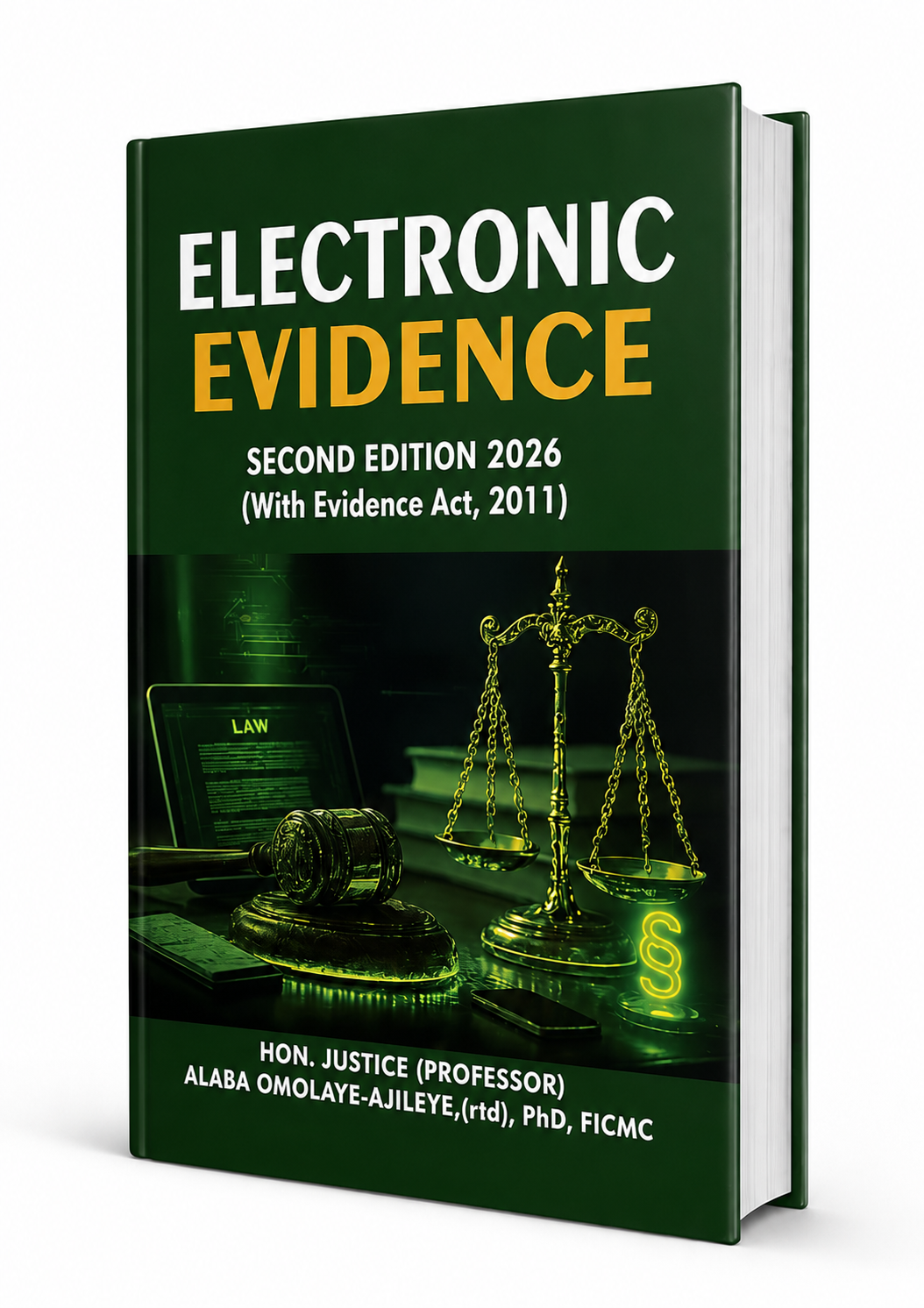
ELECTRONIC EVIDENCE, second EDITION (With Evidence Act, 2011)
Overview
This second edition builds upon the foundation laid in the first edition, with focus on simplifying the complex and ever-evolving law of electronic evidence. Recognizing the importance of judicial precedents in shaping the legal landscape, the book places strong emphasis on distilling the principles of electronic evidence that have emerged from the judgments of courts.
Through a meticulous analysis of relevant case law, it identifies, collates, and elucidates the key principles that govern the admissibility, authenticity, and reliability of electronic evidence. These principles provide the practical application of the law of electronic evidence in Nigeria. By adumbrating these principles, the book aims to provide legal practitioners, judges, law enforcement officers, and forensic experts with a clearer understanding of the legal framework governing electronic evidence. The overarching objective is to facilitate more effective and efficient litigation and improve the administration of justice in Nigeria and around the world.
Structure of the Book
The work has been carefully structured in a straightforward and logical manner to enable readers gain clear insight into the issues discussed. For ease of reference, navigation, and systematic treatment of the subject matter, the book is broadly divided into four distinct parts:
Part I: Provides a general introduction to fundamental concepts underpinning the Law of Evidence, including computers, electronic evidence, digital signatures, and the meaning of “document.”
Part II: Concentrates on the admissibility of electronic evidence before and after the introduction of Section 84 of the Evidence Act 2011 (as amended), including judicial interpretations, authentication requirements, relevancy, certification, and exceptions developed by the courts.
Part III: Examines distinct categories of electronic evidence, including electronic business records, emails, SMS and instant messaging, audio and video recordings, digital photographs, Internet printouts, social media posts, ATM records, confessional statements, and BVAS.
Part IV: Provides relevant statutes and legal frameworks, including the Evidence Act 2011 (as amended), UNCITRAL Model Law on Electronic Signatures (2001), and the Commonwealth Model Law on Electronic Evidence.
Purpose and Approach
This revised text aims to provide an adequate and up-to-date guide to the state of the law of electronic evidence in Nigeria. The work includes references to other jurisdictions where relevant, recognizing that the subject remains in flux and will continue to evolve.
In this edition, greater emphasis is placed on practical application rather than purely theoretical discussion, particularly on how authentic electronic documents are skilfully presented and accepted by the courts in the interest of justice. The author’s experience as a trial court judge provides valuable insight in this regard.
It is hoped that this second edition will serve as a trusted and authoritative guide in the rapidly evolving field of electronic and digital evidence, and contribute to the development of a more robust legal framework in Nigeria and beyond.
-
Author: Hon. Justice (Prof.) Alaba Omolaye-Ajileye (Rtd), PhD, FICMC -
Year: 2026
Make a Pre-order (Book Launch, July 2, 2026)
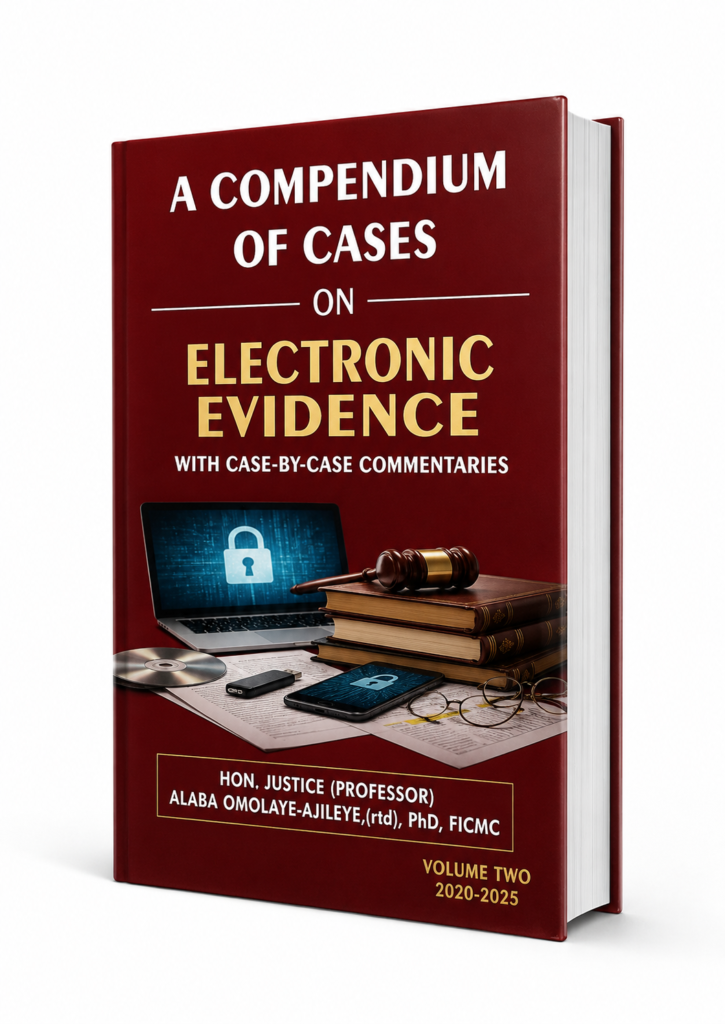
A compendium of cases on electronic evidence, (Volume two, 2020-2025)
Overview
This second volume of A Compendium of Cases on Electronic Evidence (ACCEE) builds upon the foundation established in the first volume by providing a further compilation and analysis of judicial authorities that define and shape the law of electronic evidence in Nigeria. The work continues its focus on interpreting the provisions of the Evidence Act 2011, particularly Section 84, alongside other statutory principles governing electronically generated materials.
Recognising the rapid growth of judicial decisions in this area, the volume includes additional authorities addressing critical issues such as computer-generated documents, internet printouts, digital records, certification, authenticity, probative value, and the procedural requirements for admissibility. Through the careful selection and organisation of these decisions, the book seeks to clarify emerging legal principles and provide a reliable reference point for understanding the evolving jurisprudence of electronic evidence.
A distinctive feature of this volume is its emphasis on analytical case-to-case commentaries. Beyond merely reporting judicial decisions, the work examines their doctrinal significance and places them within the broader development of the law. This approach enables readers to better appreciate the reasoning of the courts and the practical implications of key decisions in modern litigation.
Structure of the Book
The volume is carefully arranged to serve as a practical and accessible research resource. It presents selected judicial authorities on electronic evidence together with distilled legal principles and analytical commentaries designed to facilitate understanding and application.
The book systematically:
-
Compiles relevant judicial decisions on electronic evidence.
-
Extracts and highlights the governing legal principles from each case.
-
Provides case-to-case analytical commentaries explaining the significance of judicial reasoning.
-
Examines the development of legal standards relating to admissibility, authenticity, certification, and evidential weight.
-
Traces the continuing evolution of jurisprudence under the Evidence Act 2011 and related legal frameworks.
This structured approach enables readers to quickly identify relevant authorities while also appreciating the broader doctrinal trends shaping the law.
Purpose and Approach
The primary objective of this volume is to serve as a practical research and reference tool for judges, legal practitioners, academics, and students. By bringing together carefully selected authorities and presenting them in a systematic and analytical manner, the work seeks to simplify the complexities associated with electronic evidence and assist users in applying the law effectively.
The volume also reflects the judiciary’s continuing effort to reconcile traditional principles of the Law of Evidence with the realities of an increasingly digital world. As electronic evidence has become a routine feature of litigation, the need for a clear understanding of the legal standards governing its admissibility and evidential value has never been greater.
Through its combination of judicial authorities, distilled principles, and analytical commentaries, this work aims to contribute to a deeper understanding of electronic evidence and to support the continued development of a coherent and reliable body of jurisprudence in Nigeria. It is intended to complement the first volume and provide readers with a comprehensive guide to the evolving law of electronic evidence, while recognising that future technological developments and judicial decisions will continue to refine and expand the principles discussed.
-
Author: Hon. Justice (Prof.) Alaba Omolaye-Ajileye (Rtd), PhD, FICMC -
Year: 2026